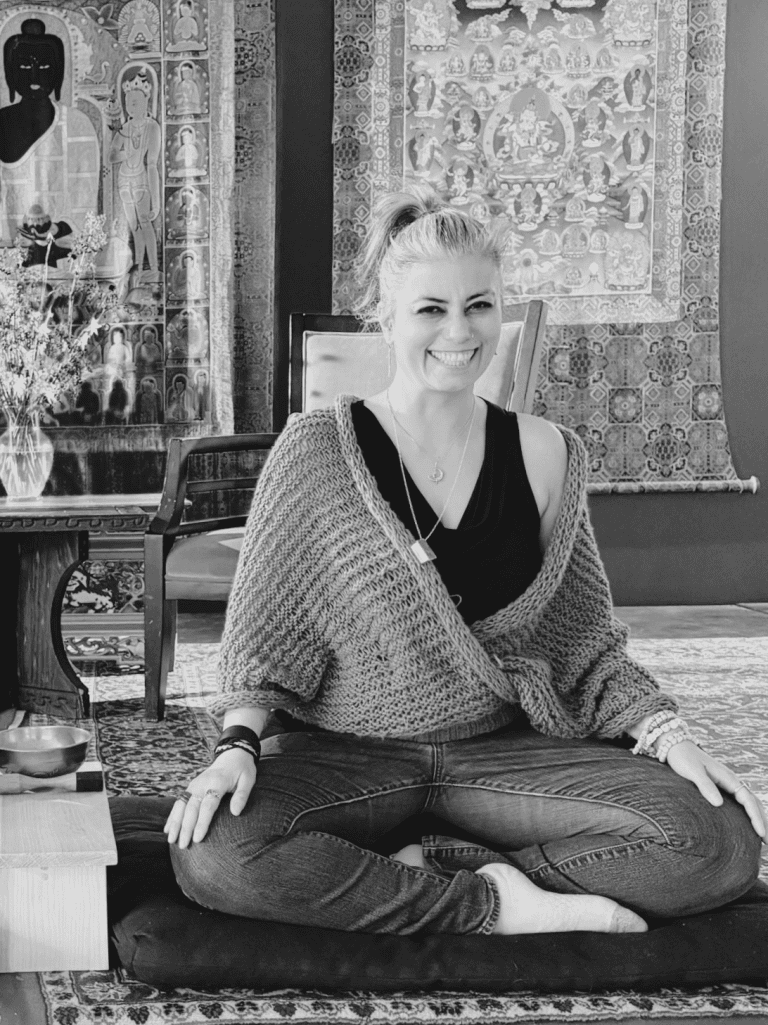
I’m a certified mindfulness meditation teacher, death doula, and community advocate. My path in practice started in anxiety and a practice that was too rigid to actually hold me — it took years of unlearning to find something sustainable, and that experience shapes everything about how I teach now: collaboratively, individually, and with a lot of curiosity about what each person actually needs, rather than a fixed idea of what practice is supposed to look like.
I came to meditation hoping it would make me less anxious. It didn’t — not in the way I imagined. What it did do was shift my relationship to anxiety, into something I could work with instead of something I needed to defeat. My first real practice was rigid and austere, a poor fit for what I needed — and not knowing there were other options, I just assumed I was bad at meditating. I eventually found a practice that was gentler, one that welcomed my questions as part of the journey rather than a disruption to it.
There was a turning point in my own practice — realizing that pushing my body through more pain than necessary, because I thought that’s what “good meditation” looked like, wasn’t the path to liberation. The only person who could know whether I was truly in practice was me. That came with a new responsibility: staying curious enough to keep asking what’s enough effort to learn something new, without causing unnecessary harm — a question whose answer keeps shifting, depending on the day, the body, the nervous system involved.
I believe community care and self-care can’t be separated — they’re equal, intertwined parts of a practice of liberation. Self care is community care is self care. We live in an intrinsically interconnected world while many of us struggle to navigate isolating systems and individualistic communities. Mindfulness and other intentional practice are tools of revolution or can be — training that equips and resources us to make change, not a replacement for it. We can’t meditate the world into the change it needs. But I do believe we need to be resourced, sustained, and connected enough to keep doing it.
As a Buddhist, Buddhist principles show up in my teaching where they’re relevant and helpful. I’m equally glad to work explicitly from within a Buddhist framework with those looking for that, or to draw more loosely on those teachings for those who aren’t. A relationship to Buddhism or any other practice is not necessary, the way I work with people can be applied and integrated into any/all lifestyles and belief systems one may have.
A little bit more history: I earned my black belt at 17, have an extensive professional background in advocacy work with at-risk youth, queer communities, intimate partner violence and sexual assault prevention and intervention, and grief and crisis support. Much of this grew out of my own experience and learning that the things that once made me feel most isolated are actually what fostered the most real human connection, once I started to let go of the idea I needed to fit into systems that demand people to be smaller or more convenient than they are.
Boston born and raised, I bring a little sarcasm to most things, alongside an insatiable curiosity that can teeter on rambling when I’m enthusiastic about a topic. I teach and coach as both an imperfect human and someone with specific training, life experiences, and skills. I meet people where they are, and take seriously the responsibilities I feel to my students, my community, and all sentient beings, while also holding needed humor and levity.
I’m not everyone’s jam, and I don’t aim to be. Reach out if you want to find out what working with me could look like for you and if it’s feels like a good fit!